If you’ve ever driven past roadworks, you’ve probably seen someone in a bright vest holding a stop/slow sign, helping cars get through safely. It might look easy from your car, but traffic control is an important job. It has clear rules, real safety risks, and big responsibilities.
If you want to work in this field, the first step is to join a traffic control course — whether you’re based on the Gold Coast or elsewhere.. But what do these courses actually teach you? This guide will take you through it—from the basic rules you’ll learn, to the hands-on skills you’ll practise, and finally how Spotto Traffic Control can help you start a safe and rewarding career.
What Do Traffic Control Courses Teach? From Theory to Hands-On Safety

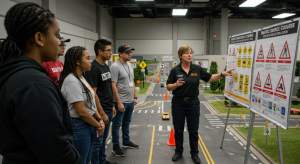
Traffic control courses teach you in two main ways: theory and practical training. Theory is about learning the rules, laws, and safety steps you must follow. Practical training is when you practise those skills on a real or simulated work site. Both are important—knowing the rules doesn’t help if you can’t use them in real life.
In Australia, these courses follow national training units such as RIIWHS205E (how to control traffic with a stop/slow sign) and RIIWHS302E (how to set up and follow a traffic management plan). These units meet strict workplace health and safety standards to help stop accidents, keep workers safe, and protect the public.
A good course will teach you how to:
- Understand road safety legislation and why compliance is non-negotiable.
- Identify hazards before they become problems—like spotting poor visibility or distracted drivers.
- Communicate effectively with team members and road users to keep everyone informed.
Safe Work Australia states that providing workers with the right training helps them perform tasks safely, use equipment correctly, and follow safe work procedures (Safe Work Australia, n.d.).
What You’ll Actually Learn in a Traffic Control Course: Skills You’ll Master

Once you’ve covered the basics, the course dives deeper into the skills you’ll need every day on the job.
Core Theory Modules
- Road rules & WHS compliance
Learn the national and state-specific laws governing traffic control. This includes understanding signage, speed restrictions, and safe work distances. - Risk assessment & hazard spotting
You’ll be trained to scan the environment and identify risks like blind corners, uneven surfaces, or changing weather. - Clear communication
Whether it’s through hand signals, two-way radios, or verbal instructions, you’ll learn how to direct drivers and coordinate with your crew.
Practical, On-Site Skills
- Using stop/slow bats and signage
You’ll practise the correct stance, posture, and timing to control traffic flows safely and smoothly. - Setting up work zones
This means correctly placing cones, barriers, and signs to create a safe work area that meets legal standards. - Radio operation
On-site conditions can be noisy and unpredictable. You’ll learn how to communicate clearly via radio to coordinate with your team.
Emergency & Incident Response
- Acting quickly in emergencies
If an accident occurs, you’ll know how to alert emergency services and secure the site to prevent further harm. - Working with first responders
Training covers how to assist police, paramedics, or fire crews when needed. - Incident reporting
You’ll learn the correct procedure for documenting what happened—an important part of WHS compliance and insurance.
Quick Reference: Skills & Modules in a Traffic Control Course
| Skill Area | What You’ll Learn | Industry Unit Code |
| Theory | WHS compliance, road rules, risk assessment | RIIWHS205E, RIIWHS302E |
| Practical | Stop/slow bat operation, signage placement, cone/barrier setup | RIIWHS205E |
| Communication | Two-way radio use, clear verbal instructions, hand signals | RIIWHS205E |
| Emergency Response | Incident control, first responder coordination, reporting procedures | RIIWHS302E |
| Site Management | Implementing and maintaining Traffic Management Plans | RIIWHS302E |
At Spotto, trainers often share real-world stories from years on the job to prepare you for situations you might not find in the training manual. As one trainer puts it:
“In years, I’ve seen how quick thinking and solid skills prevent harm. Training isn’t just about passing—it’s about being ready for whatever the road throws at you.”
This combination of theory and hands-on practice ensures you leave the course confident and job-ready.
See the Full Breakdown of Spotto’s Course Modules & Start Learning

Once you know what’s covered in a traffic control course, the next step is choosing the right training provider. Spotto Traffic Control delivers nationally recognised training in partnership with ACTA Group (RTO 45370), ensuring you meet all legal and industry requirements.
Course Module Overview
- Control traffic with stop/slow bat (RIIWHS205E) – Teaches the safe use of stop/slow bats to control traffic flow.
- Implement traffic management plans (RIIWHS302E) – Covers setting up, maintaining, and removing traffic control devices.
- Optional White Card training – Required for work on construction sites.
Courses are delivered face-to-face or through blended learning, combining classroom theory with practical on-site simulations. Training is offered at convenient locations across Queensland and New South Wales.
Why Spotto Stands Out
- Industry-experienced trainers who’ve worked in real traffic management roles, not just in classrooms.
- Job-ready focus—training includes realistic setups and actual equipment so you feel prepared from day one.
- Strong employment outcomes thanks to Spotto’s reputation with employers in the industry.
Infrastructure Australia projects a shortfall of about 105,000 workers in the public infrastructure sector by 2023, including skilled roles such as traffic control (Infrastructure Australia, 2023).
How to Enrol & What’s Next
Getting started with Spotto is simple:
- Choose your course – Select from available dates and locations.
- Book online – Fill in your details and confirm your spot.
- Attend training – Complete both theory and practical components.
- Get certified – Upon successful completion, receive your nationally recognised qualification.
Final Call to Action
If you’re ready to build a safe, in-demand career, the next step is simple:
Enrol in Spotto’s nationally recognised traffic control course today and start mastering the skills that keep Australia moving. Visit Spotto’s course page to check dates, locations, and secure your spot.
New to Traffic Control? Learn the Basics Here.
- What Is Traffic Management and Why It Matters on Aussie Roads
- Career Progression in Traffic Control Jobs: Roles, Pay & Growth
- Traffic Controller Course Modules Explained – What to Expect & How to Get Certified
- Book Certified Controllers for Traffic QLD Events